
Cleveland County Court Records After Arrest
The court path after a Cleveland County jail arrest starts with custody, but it does not end with the roster. The Cleveland County Sheriff's Office, led by Sheriff Alan Norman, books the person into the local detention system and may publish custody details through the official P2C Inmate Inquiry. The court record is separate. It is the criminal case record kept through the North Carolina Judicial Branch after charges, court dates, bond conditions, and docket numbers are assigned.
A P2C profile can be the bridge between arrest records and court records because it may show a next court date, charge rows, docket numbers, bond labels, and a pretrial status. For custody and booking fields, use Cleveland County jail inmate records. For booking photos, use Cleveland County jail mugshots. Court records after an arrest focus on the charge filed in District or Superior Court, how the State proceeds, and whether each charge is still pending, changed, dismissed, or resolved.
The formal prosecution role belongs to the District Attorney's Office for Prosecutorial District 39. District Attorney Mike Miller serves Cleveland and Lincoln counties. The DA reviews criminal cases, prepares criminal trial dockets, represents the State, and can amend, reduce, dismiss, or replace charges after a jail arrest. That is why an early booking charge should not be read as the final court charge or as a conviction.
Find Cleveland County Court Arrest Records
The NC Judicial Branch Cleveland County page is the local court hub for court dates, calendars, forms, and services. For case records, the Judicial Branch routes users to online Portal services, public self-service terminals, and the Clerk of Superior Court. The most precise search starts with the docket or case number shown on a P2C charge row. If no number is visible, search by defendant name and narrow the result to Cleveland County.
- Start with the jail profile and copy the full name, arrest date, charge language, docket number, bond amount, and next court date if shown.
- Search the NC Judicial Branch Portal by case number first. A case number is less likely to return the wrong person than a broad name search.
- If the case number is missing, search by defendant name, then filter or compare results by county, charge, court date, and date of birth where available.
- Open the case record and read each charge row. Check the charge level, status, scheduled hearing, and disposition if the court has taken final action.
- For records that are not online, use a public terminal or ask the Cleveland County Clerk of Superior Court about paper file access and copy rules.
The Judicial Branch court-records help page states that criminal case information can be searched at a public self-service terminal by defendant name, case number, or victim or witness name. Online Portal materials also refer to name, attorney, citation, court date, and hearing search paths. Paper files may require a visit to the clerk's office in the county where the case is located.
The official court-records help source is shown in the screenshot below from the North Carolina Judicial Branch: NC court-records help.
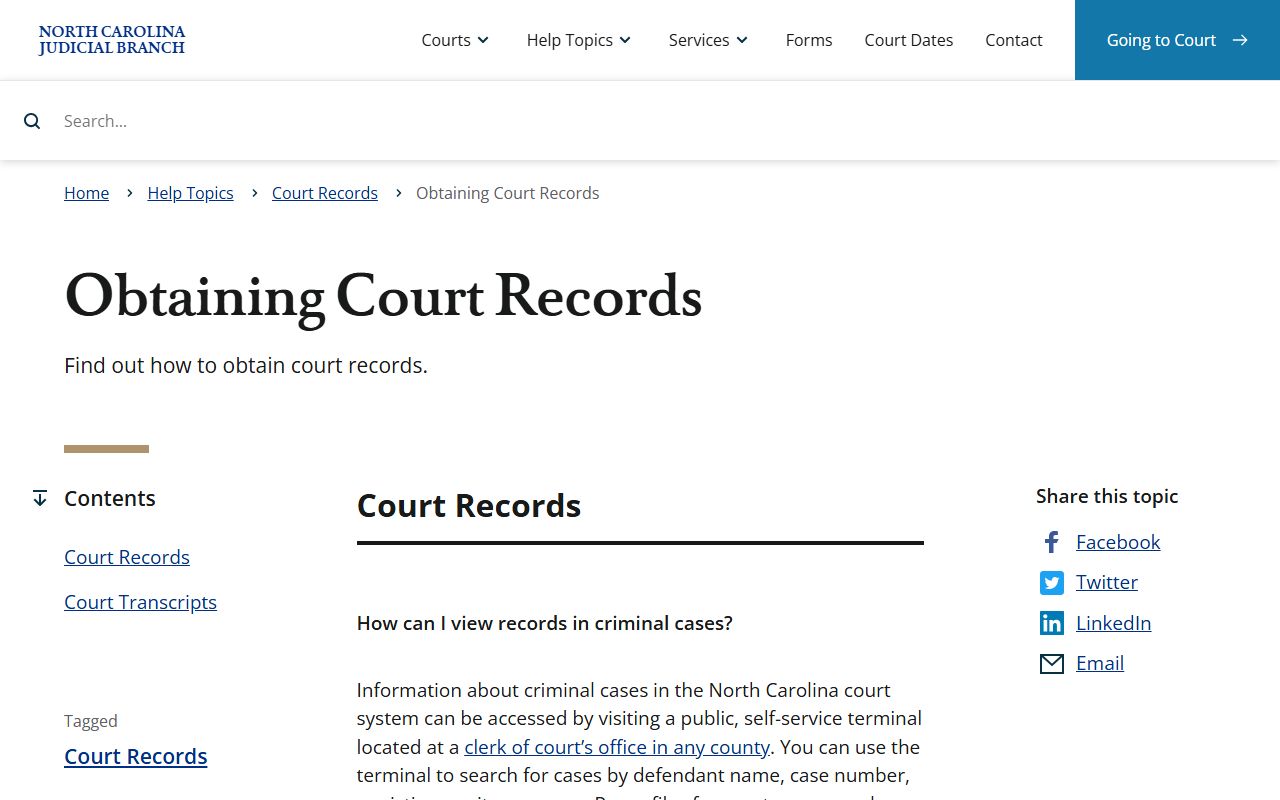
That source is useful because Cleveland County court records after a jail arrest may be found online, at a terminal, or in a paper file depending on the case and document type.
| Field Label | Type | Required | Options / Format Notes |
|---|---|---|---|
| Defendant name | Text | One search path | Use full name from the jail record when possible. |
| Case number | Text | One search path | Use the docket number from a P2C charge row when shown. |
| Victim or witness name | Text | One search path | Public terminal option for criminal case information. |
| Attorney | Text | Optional | Portal information says attorney searches are available. |
| Citation | Text | Optional | Useful for traffic or citation-based criminal matters. |
| County | Dropdown/filter | Often needed | Choose Cleveland County when using a statewide court system. |
Cleveland County Arrest Charging Papers
After a Cleveland County arrest, the first jail charge may use process language that does not read like a final court pleading. The research sample included terms such as magistrate order and OFA, plus docket numbers tied to individual charge rows. Court records after a jail arrest should be checked against the filed criminal case because the DA may proceed by different charging documents as the matter moves from arrest to court.
| Document Type | Who Uses It | What It Does |
|---|---|---|
| Complaint or magistrate process | Officer, magistrate, or prosecutor | Starts or supports the early charge path after arrest and first appearance. |
| Information | Prosecutor | States the charge the State intends to pursue without relying only on the jail booking label. |
| Indictment | Grand jury and prosecutor | Can replace or supersede earlier charges, especially in serious felony cases. |
The name of the paper matters less than the legal effect. A person can be booked on one label, appear in court under another, and later face an amended or reduced charge. The case file, not the jail grid alone, is the record to use when checking what charge is pending in court.
Cleveland County Charge Status Records
Charge status is one of the main reasons to check court records after a jail arrest. A Cleveland County P2C profile may show PRE-TRIAL, bond, and a court date, but the court file records what has happened after filing. Charges may be pending, amended, reduced, dismissed, disposed, or resolved by conviction. North Carolina pages may use ordinary dismissal language instead of Latin terms such as nolle prosequi.
| Status | What It Means |
|---|---|
| Pending | The court has not taken final action on that charge. |
| Amended | The wording or legal basis of the charge changed by court or prosecutor action. |
| Reduced | The charge was replaced by a lesser charge. |
| Dismissed | The charge ended without a conviction on that count. |
| Disposed | The court has taken final action, such as judgment, plea, dismissal, or another disposition. |
| Conviction | Guilt was established by plea, verdict, or judgment. |
Note: Jail roster charges can lag behind court action, so confirm the current charge status with court records or the clerk.
Bond After Cleveland County Arrest
Bond is part of the arrest-to-court pathway, but it is not the same as the charge result. Cleveland County P2C profiles publish bond information by charge and as a total bond amount when available. The inspected profile showed secured bond rows and included rows, which means some charge lines may not carry a separate release amount. Pages should not read an included bond row as a dismissal or a final court outcome.
North Carolina pretrial release is governed by criminal procedure rules in Chapter 15A. Practical release conditions can include a written promise to appear, custody release, unsecured bond, secured bond, cash or security bond, supervision, or restrictions. If a hold, detainer, probation matter, OFA, or another agency warrant exists, posting the visible bond may not result in release.
| Bond Type | How It Works |
|---|---|
| Written promise | The person signs a promise to appear in court. |
| Unsecured bond | Release is allowed without paying up front, but payment can be owed after failure to appear. |
| Secured bond | Money, property, or a surety must secure the release amount. |
| Cash or security bond | The court requires a cash deposit or approved security. |
| No-bond hold | Release is blocked until a court, magistrate, or holding authority changes the condition. |
Verify bond with the jail, magistrate, or clerk before travel. Cleveland County bond questions can involve the Cleveland County Detention Center, the control room, the magistrate, or the Clerk of Superior Court, depending on the time and status of the case.
Cleveland County Warrant Arrest Records
A warrant can be the reason a person appears in jail, but Cleveland County did not have a separate documented active warrant search field table in the captured official sources. The sheriff P2C navigation includes Most Wanted and Arrests. Those are official law-enforcement publication channels, not complete warrant databases. A Most Wanted listing may show selected wanted-person information when active, while an Arrests entry may help connect a later booking to a warrant service.
Common warrant and process terms include arrest warrant, order for arrest, bench warrant, search warrant, fugitive warrant, probation hold, and parole hold. The P2C sample used OFA language, which often points to a court order or failure-to-appear process. If the court record shows an OFA or another warrant-based process, the person may need a court or magistrate action before a release condition changes.
Important: A warrant record is not the same as a conviction, and a public wanted-person page is not a full warrant index.
Cleveland County Charges vs Convictions
Charges and convictions are often mixed up in casual searches. A charge is an accusation or court filing. A conviction is a final result based on a plea, verdict, or judgment. Cleveland County court records after a jail arrest can show both, but the words do not mean the same thing. Treat a roster charge and a pending court charge as unresolved unless the case record shows a final disposition.
| Point | Charge | Conviction |
|---|---|---|
| Stage | Filed or alleged after arrest | Entered after plea, verdict, or judgment |
| Proof | Based on criminal process and probable cause standards | Based on proof beyond a reasonable doubt or a valid plea |
| Can Change | Can be amended, reduced, dismissed, or replaced | Can be appealed, corrected, or affected by later relief |
| How to Confirm | Read the current court case record | Read the disposition and judgment record |
Sealed and Expunged Arrest Records
Public access to Cleveland County court records after arrest is broad, but it has limits. North Carolina public-records law defines public records broadly through N.C. Gen. Stat. 132-1 and requires inspection and copies under N.C. Gen. Stat. 132-6. At the same time, N.C. Gen. Stat. 132-1.4 excludes criminal investigation and criminal intelligence records from the public-record definition. Chapter 15A also controls criminal procedure and expunction-related issues.
| Record Treatment | Plain Meaning | Public Access Effect |
|---|---|---|
| Sealed | Access is restricted by law or court order. | The public may not be able to view the record, though limited official access may remain. |
| Expunged | An eligible record is cleared through a legal process. | The public record may be removed or treated as unavailable under the expunction order. |
| Criminal investigation record | Law-enforcement investigative material. | May be withheld even when some arrest or court facts are public. |
Dismissal does not automatically make every linked record vanish from all systems. A person seeking record clearing should use the court process, not a private shortcut. Juvenile matters, sealed records, expunged cases, and some investigative materials may be restricted even when an arrest once appeared in a public jail or court channel.
Cleveland County Court Contacts
Court-record questions should be routed to the office that keeps or controls the record. The Cleveland County Courthouse is listed by the Judicial Branch at 100 Justice Place, Shelby, NC 28150, with main phone 704-476-7800 and public hours Monday-Friday 8:30 a.m.-5:00 p.m. The contact directory also lists the District Attorney, magistrate, and after-hours magistrate numbers for court and first-appearance issues.
The local courthouse source is shown here: Cleveland County Courthouse page.
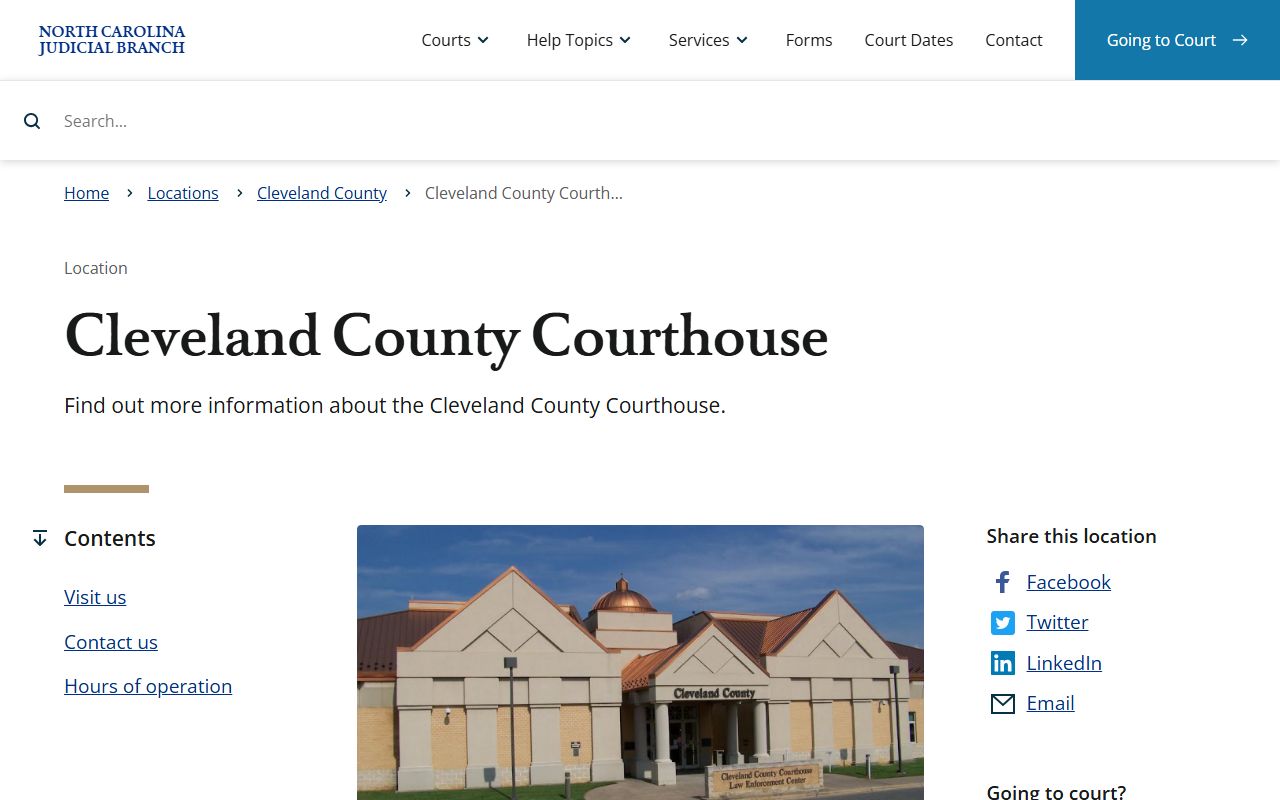
The courthouse page matters because the clerk, court dates, magistrate process, and courtroom records are separate from the sheriff's jail roster.
Cleveland County Courthouse
100 Justice Place
Shelby, NC 28150
704-476-7800
Monday-Friday 8:30 a.m.-5:00 p.m.
District Attorney, Prosecutorial District 39
314 East Marion Street
Shelby, NC 28150
704-476-7810 or 704-476-7811
District Attorney Mike Miller
Cleveland County Record Use Limits
Cleveland County court records after a jail arrest can help identify the case path, but they should be read in context. A court record can be incomplete online, a jail roster can be delayed, and a charge can change after prosecutor review. For consumer decisions, casual public-record searching is not a substitute for a lawful background-check process that complies with the Fair Credit Reporting Act and any other applicable rules.
Important: Do not use jail, arrest, or court information from public lookup pages for credit, job, housing, insurance, or other FCRA-covered decisions.